2026.03.26
Technology or spirit? The answer is "the mind moves the body" - Shota Imanaga × SHOLAYERED Interview - Part 1
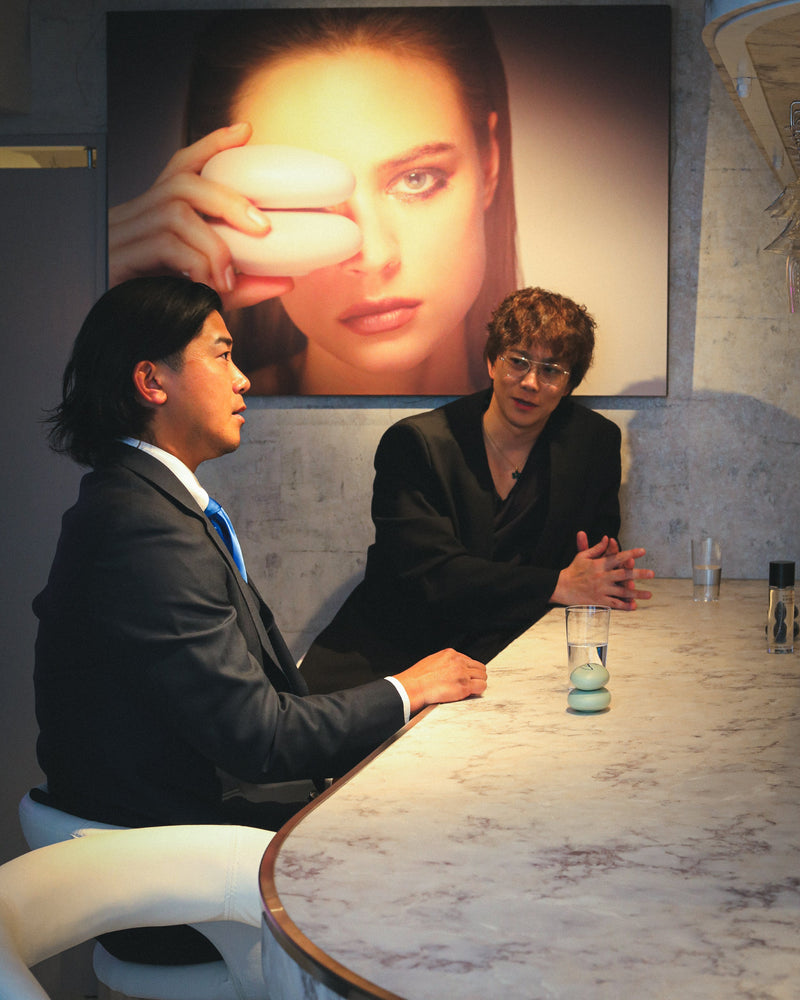
Shota Imanaga × SHOLAYERED
Dialogue Part 1

Mid-140s fastball and an unexpected encounter - Rising to prominence in college
In college, did you feel like you rapidly rose to prominence, or got on a fast track?
Back then, there weren't many left-handed pitchers throwing in the mid-140s, so I was throwing that fast since my first year. Things went smoothly until my third year, when we became national champions. Up to that point, I felt like I was steadily climbing the ladder, or rather, sprinting up it. I saw a future where I'd naturally become a professional baseball player, but then I got injured in my fourth year. I missed the entire spring league season and couldn't pitch in a single game. Even after I recovered, I was very anxious about whether I'd be okay. I ended up becoming a professional baseball player through the draft, but my college life was a mix of both rising to prominence as a baseball player and experiencing setbacks.
By the time you were in high school, had you already become an outstanding pitcher, prominent in your local area?
Not really. It just happened that the coach of an opposing team I played in a practice game was an alumnus of Komazawa University. He noticed me and introduced me to the university. I remember starting to appear in magazines around March or April of my third year.
So, the opposing coach taking notice of you was likely because of your speed, right?
Yes, speed and control. My form wasn't particularly quirky either. I guess they saw me as having a lot of potential, like I could become anything.
From there, you got on track, but then you got injured in your fourth year of college. How did you overcome that?
At that time, I was truly desperate. I felt an immense impatience about not being able to do things anymore. "Why did things turn out this way when I used to be able to do them?" I learned that unless you meticulously address each challenge one by one, you can't return to where you were. When things go smoothly, you might skip a step or two, but it's not always going to be easy. I realized then that life isn't that simple, so I learned that it's important to take things one step at a time, even after turning pro.

Photography: SHOLAYERED
"I need to fix it quickly, but I can't rush" - The wall of professionalism and the choice of surgery
Since your college injury, have you had any further injuries up to today?
I injured my shoulder in my third year as a pro, and I thought it had healed in my fourth year, but it recurred in my fifth year, and I had shoulder surgery once in my fifth year. That was the last one.
Did that college injury experience help you then?
The lesson that I had to clear things meticulously came in handy. However, on the other hand, the world of professional baseball doesn't wait for you as much as you think. Baseball is my job, and not being able to play it means dealing with the expectations of fans, and from a business perspective, my salary is involved, which created immense pressure that almost crushed me. I had a conflict between needing to recover quickly and knowing I couldn't rush.
How do you overcome that pressure?
In the back of my mind, I always had the confidence that if I could just heal this injury and perform at my best, I could definitely overcome any adversity. I constantly held onto that feeling and made sure not to forget it.
"I think it's important to reach a state where it feels wrong not to do it, to reach that level."
Shota ImanagaThe true nature of confidence is the accumulation of "doing" - The meaning of thickening the trunk
I see. Where do you think that confidence comes from?
That's right, I also think every day about how to gain confidence, but the simple conclusion is that you just have to do what you have to do. From the moment I wake up in the morning until I finish practice and go home, I just have to do what's assigned to me. It doesn't matter if I'm motivated or not; it has absolutely no bearing. I just calmly do what I need to do. When that becomes a habit, it turns into my confidence, to the point where it feels wrong not to do it. I think reaching that stage is important.
I see. That applies to all work, or perhaps even life itself. This is my personal theory, but I believe the most important thing in life is to establish reliable routines. Once you have this, even when your spirits are low or you feel anxious, you can always return to the routines you've built in the past. In the end, that's the most reassuring thing. And you've been doing that unconsciously, while also being somewhat aware of it, right?
That's right. It applies to both baseball skills and mental aspects, but if you have the reassurance of a place to return to, you can challenge yourself in various ways. Of course, there's no fear of change, and on that premise, you firmly build your own strong trunk, and branches and leaves grow from that trunk. It's important to continuously thicken the trunk you possess.
Ultimately, having confidence is extremely important, and routines are there for that. I think that's the most crucial thing in life. If your self-esteem is inherently low, you tend to fall into self-negation when faced with difficulties. When you're in a pinch, I believe what ultimately protects you is an illogical sense of self-esteem, something like that.
You might think this is an abrupt transition to talking about fragrances, but one of the indicators I use to gauge my mental state is whether I'm consistently wearing perfume. When various problems and troubles arise daily, and things don't go as planned, I lose the mental space to wear perfume. You can go out without perfume, and a day can still function without it. So, when I'm under pressure, I sometimes end up not wearing it all day.
Therefore, the more I feel pressured, the more I consciously try to wear perfume. Then, just like with routines I mentioned earlier, simply having a familiar scent there can somehow invigorate me a little. After working with perfumes for so long, I really do get that feeling.
No matter what path I take, I live my life feeling that it all comes down to how well I can keep my mental state in order.

"What a happy place I'm in" - The bird's-eye view from the mound at Tokyo Dome
I also watched the opening game at Tokyo Dome last year, and Shota-kun's mental stability is incredible. Weren't you nervous?
Of course, I was nervous... but it felt like there was the real me who was nervous, and then another me who was observing that nervous me from a different perspective. When that other me looked down on the nervous me, I got this feeling of, "What a happy place I'm in."
First of all, how many players can pitch in this environment? Opening in Tokyo for the first time in over 20 years, and the number of pitchers who can start in a Japan opening game in the history of Major League Baseball is truly limited. To be there myself—that alone deserves applause.
But then, when I returned to the present moment on the field, it was a situation of, "I hope I don't get hit by the opposing lineup today." I kept going back and forth between these two feelings, but by the moment my name was called to step onto the mound, I had already resolved myself. I tried to maintain a demeanor on the mound that made me appear mentally stable to those around me.
I see. You looked somewhat detached. I really got the sense that you were observing your own state from a broader perspective. I think I can recognize Shota-kun's detached expression, LOL.
I might have a detached look on my face, LOL.
People who see you up close probably notice it a bit. Perhaps that's the expression you have when you're in the zone.
When I enter that state, my mind is very stable, and my performance is good too.
"There's still a part of me I don't know" - The real reason for aiming for America
You're doing incredibly well in the majors, aren't you? According to the news, your annual salary is amazing. The sport you play in Japan and America is the same, and you basically throw the same ball, but there's such a significant economic difference. It really makes you feel how big America is, doesn't it?
Yes, I strongly feel that too. The reason I aimed for America was, of course, to consider my future and life after baseball, but most of all, it was about how I could change myself. That feeling was very strong.
While I have confidence in myself, I wondered if there might be a part of me I didn't know yet. So, my goal was to challenge myself in America and discover that.
I'm incredibly happy that by challenging myself in America, I discovered aspects of myself, like this side that enjoys challenges. I'm very grateful to myself for taking on the challenge and to those who supported me.
In the world of perfumes, France, the birthplace of perfume, holds a crucial position. In fact, our brand opened a store in Paris last year. In the past, when I couldn't even imagine going to Paris, I was very focused on how to adapt to their culture and create something that would be accepted there.
However, by the time I actually went there, I was thinking about how to stay true to ourselves. After all, if a Japanese brand imitates Paris and goes there, Parisians wouldn't find it very interesting. Rather, I think Paris wants to see a collection of sensitivities nurtured in Japan, so I didn't care at all whether it would be accepted there and simply brought what we created in Japan. And it worked out very well.
Thinking about it that way, it's quite curious, and I think baseball probably has a lot of similarities in that regard, don't you agree?
Yes, that's right. When I experienced American baseball, for example, a big difference is that American baseball really values numbers, whereas Japanese baseball places a strong emphasis on intuition and theory. It's not about which is better; ultimately, it's about taking the good parts from both and interpreting them in your own way. So, I think it's important to trust what you've cultivated and go in with your own sensibility. In that respect, I think there are many similarities in what you're saying.
Discovering a new self by going to America, hearing about that, it makes me think you're constantly training, daily refining yourself towards your ideal self. Has it been like that since you were a child?
Looking back to my childhood, I've always been pretty good at continuing things. In the process of continuing, you don't always know if it's the right or wrong path at the time, do you? But I think I've developed the ability to make it the right path for myself, and from now on, I'll need to keep trying things out and making them work.
"Ultimately, I believe it's important to trust what you've cultivated and go with your own intuition."
Shota Imanaga
"The mind moves the body" - Respect for actors, and technical theory vs. spiritual theory
Is there anyone you respect outside of baseball?
Outside of baseball, it's not a person I respect, but rather a profession I respect: actors. For example, if there's someone playing a happy role and someone playing a somewhat dark role, there are times when I wonder if they're truly feeling that emotion at that moment. If someone is playing a happy role when they've had something personally sad happen, I imagine that would be incredibly difficult. The same goes for the opposite situation. I'm very curious about what kind of mental control they use to achieve that.
That's right, not just in sports but in everything else, you can't achieve anything without mental fortitude.
That's right. Technical theory and spiritual theory often clash, don't they? Until recently, I thought technique was 100% and spirit was zero. But lately, I've come to feel that it's not so; the mind moves the body. I believe that by consistently approaching things with a steady mind, performance will also stabilize. If I'm irritated or anxious, I can't put my heart into training, and even if I do, I become suspicious, wondering, "Am I really getting stronger?" But when my mind is stable, I can practice with confidence. I feel that mental stability and improving my mental state when things are not going well are extremely important for consistently delivering strong performances.
In my case, when creating perfumes, I emphasize the process of "putting my heart into it" before releasing them to the world. With that extra effort, the product spreads widely and ultimately sells well. This relates to the earlier discussion about spiritual and technical theories. For instance, in soccer's World Cup, there's "Mitoma's 1mm," which feels like a state achieved solely through mental fortitude. For pitchers, if they have strong willpower, their speed and ball rotation might increase more than usual. These aspects really resonate with the world of fragrances and perfumes. It's truly mysterious why, if you spend time putting soul into the final product, it somehow sells. But I believe such things ultimately manifest in the details, and I work with that in mind.
I think it's incredibly romantic when the audience gets caught up in my emotions and wonders what I'm feeling when I'm pitching. There was a time when I thought if I just perfected my technique, I could definitely win, but I think the answer is much more interesting when emotions are involved, so I want to be that kind of player.
Instead of 80 points from everyone, aim for 120 points from someone who truly understands you.
Imanaga-san, for example, you started in the WBC final against the United States. You pitched a strong second year and received a qualifying offer. A qualifying offer is actually a great offer. It's one of the highest possible appraisals, where a team retains a player who is a free agent, or if they're likely to be taken by another team, they get a draft pick for a higher value. It feels like you've received a tremendous appraisal, yet the Japanese media seems to underestimate it slightly. However, on the other hand, you seem to effortlessly shrug off such situations. Despite the gap between the actual appraisal and public perception, you even seem to use it to your advantage. Seeing SHOLAYERED's journey, I feel there's a connection to Imanaga-san in that regard.
From now on, please allow me to affectionately call you Shota, LOL. Actually, that's what I like most about Shota. Of course, there's public perception, but the reality is that the actual appraisal is even higher, which is a world view I really appreciate. When I see brands or players who are excessively praised by the media more than their actual worth, they often end up being swayed by that evaluation and unable to pursue the path they should have taken.
That's right. I also care about what others think and sometimes don't want to be disliked. There was a time when I tried to be an 80-point person for everyone, but I changed my mindset when I went to America. I realized it's better to aim for 120 points for someone who truly understands me and my essence, even if that means a minority. I understood that it's happier to work with people who understand me, even if they're few, and do what I need to do.
Humility, Sincerity, and Playfulness - Towards "Shota-like Scent"
Listening to you speak like this, it's truly refreshing to see you pursuing the path of baseball and refining your moral character through it.
I wonder. I don't know if I'm personally growing as a person, LOL.
Does that way of thinking come from your parents' upbringing?
I think it's partly my parents' upbringing, and also that the people supporting me give me good advice when I'm about to go in the wrong direction. And I listen to it, of course. I think being in an environment where I can do that now is the best thing. Even if it's painful to hear, you have to be open to it. Having people around who give you such opinions is really important, I think.
That humility and sincerity, supporting your adventurous spirit, are what make Shota so charming. I think it would be interesting to create a fragrance today with these elements in mind. For sincerity and such, in a Japanese context, a citrus-based fragrance that evokes a sense of cleanliness might be closest. Citrus also has a subtle quality, doesn't it?
Indeed, the impression a fragrance creates about a person is truly significant. If a fragrance smells bold, then you're perceived that way.
Exactly! Speaking of which, the 1945 Light Green that Shota uses and loves, with its citrus and green tea notes, perfectly aligns with Shota's values. I think it would be incredibly interesting to translate the adventurous spirit, the tendency to observe from a broader perspective, and the Zen-like thinking that came up in today's discussion—this feeling of "constantly looking within oneself while moving forward adventurously"—into a fragrance.